Robotics: New skin-like sensors fit almost everywhere

Researchers from the Munich Institute of Robotics and Machine Intelligence (MIRMI) at the Technical University of Munich (TUM) have made a significant breakthrough in the field of soft sensors. They have developed an automated process for creating universal measurement cells that can be attached to nearly any object. This innovation holds great potential for applications in robotics and prosthetics.

According to Sonja Groß, a researcher from MIRMI, understanding and sensing our environment is crucial for effective interaction with it. The shape of objects plays a vital role in determining how we can perform tasks, while their physical properties, such as hardness and flexibility, influence our ability to grasp and manipulate them.

In the fields of robotics and prosthetics, achieving sensorimotor skills similar to those of a human hand is a major goal. Force and torque sensors are already integrated into many robotic systems, providing valuable feedback on interactions with the surroundings. However, traditional sensors have limitations in terms of customization and attaching them to arbitrary objects. Until now, there was no process for producing sensors suitable for objects of various shapes and sizes.

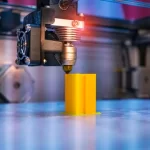
The research team, led by Sonja Groß and Diego Hidalgo, has developed a new framework for soft sensors, which they recently presented at the ICRA robotics conference in London. Their approach involves using a soft, skin-like material that wraps around objects. They have also created a software-driven production process that automates the manufacturing of these sensors. A 3D printer is employed to inject a conductive black paste into liquid silicone, which then hardens. The resulting sensors exhibit changes in electrical resistance when squeezed or stretched, providing information about compression and stretching forces. This data helps understand interactions with objects and enables precise control of artificial hands interacting with the environment.

What sets this research apart is that the sensors embedded in the silicone adjust to the surface they are applied to, such as fingers or hands, while still delivering precise and valuable data for interaction with the environment.

Prof. Sami Haddadin, the Executive Director of MIRMI, believes that integrating these soft, skin-like sensors into 3D objects opens up new possibilities for advanced haptic sensing in artificial intelligence. The real-time feedback from these sensors on compressive forces and deformations expands the perception range of objects or robotic hands, enabling more sophisticated and sensitive interactions. Haddadin envisions this breakthrough revolutionizing industries like robotics, prosthetics, and human-machine interaction, making it possible to create wireless and customizable sensor technology for a wide range of objects and machines.

Posted in

Aihub Team

Leave a Comment


Yuval Noah Harari: AI and the future of humanity | Frontiers Forum Live 2023

Yuval Noah Harari: AI and the future of humanity | Frontiers Forum Live 2023

OpenAI created a PHYSICAL ROBOT?! (NEO = GPT-5 WITH BODY)

OpenAI created a PHYSICAL ROBOT?! (NEO = GPT-5 WITH BODY)

London Conference 2023: How can countries respond to great power competition?

London Conference 2023: How can countries respond to great power competition?

AI vs Machine Learning

AI vs Machine Learning

Interview with Mr.Yoshua Bengio

Interview with Mr.Yoshua Bengio

Interview with Mr.Nick Bostrom

Interview with Mr.Nick Bostrom

Interview with Mr.Stuart J. Russell

Interview with Mr.Stuart J. Russell

This 3D printed gripper doesn't need electronics to function

This 3D printed gripper doesn’t need electronics to function

Robotic hand rotates objects using touch, not vision

Robotic hand rotates objects using touch, not vision

Researchers develop low-cost sensor to enhance robots' sense of touch

Researchers develop low-cost sensor to enhance robots’ sense of touch

Reinforcement learning allows underwater robots to locate and track objects underwater

Reinforcement learning allows underwater robots to locate and track objects underwater

Artificial Intelligence Microscopy Market is Going to Boom | CAMECA, Celly.AI Corporation, Hitachi High-Tech Corporation, JEOL Ltd., Life Technologies Corporation, a Thermo Fisher Scientific company, Motic

Artificial Intelligence Microscopy Market is Going to Boom | CAMECA, Celly.AI Corporation, Hitachi High-Tech Corporation, JEOL Ltd., Life Technologies Corporation, a Thermo Fisher Scientific company, Motic

The Importance of Creating a Culture of Data

The Importance of Creating a Culture of Data

Scaling the AI Ladder

Scaling the AI Ladder

How to Accelerate the Use of AI in Organizations

How to Accelerate the Use of AI in Organizations

How IBM and Salesforce Are Challenging Traditional Business Models

How IBM and Salesforce Are Challenging Traditional Business Models

Future Designers Unleash Creativity with AI

Future Designers Unleash Creativity with AI

Five Emerging Trends in Technology Support Services

Five Emerging Trends in Technology Support Services

A Parable: “The Blind GPUs and the Elephant”

A Parable: “The Blind GPUs and the Elephant”

A New Wave: Transforming Our Understanding of Ocean Health

A New Wave: Transforming Our Understanding of Ocean Health

UN Security Council to hold first talks on AI risks

UN Security Council to hold first talks on AI risks

The Problem With Suing Gen AI Companies for Copyright Infringement

The Problem With Suing Gen AI Companies for Copyright Infringement

SEC’s Gary Gensler Believes AI Can Strengthen Its Enforcement Regime

SEC’s Gary Gensler Believes AI Can Strengthen Its Enforcement Regime

Robotics: New skin-like sensors fit almost everywhere

Robotics: New skin-like sensors fit almost everywhere

Labour Outlines Law to Ban Training AI Chatbot to Spread Terror

Labour Outlines Law to Ban Training AI Chatbot to Spread Terror

Winning with AI

Winning with AI

Watson Anywhere: The Future

Watson Anywhere: The Future

DataFam Roundup

DataFam Roundup

AI is Not Magic: It’s Time to Demystify and Apply

AI is Not Magic: It’s Time to Demystify and Apply

AI in 2020: From Experimentation to Adoption

AI in 2020: From Experimentation to Adoption