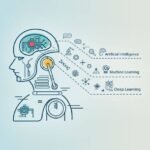
Machine Learning vs. Deep Learning

In the realm of artificial intelligence (AI), two terms often mentioned are machine learning and deep learning. While both techniques involve training algorithms to make predictions or perform tasks, they differ in their underlying principles and applications. In this blog, we will explore the distinctions between machine learning and deep learning, shedding light on their strengths, limitations, and real-world applications.

Understanding Machine Learning:

Machine learning is a subset of AI that focuses on algorithms and models that enable computers to learn from data and make predictions or decisions without being explicitly programmed. It involves the use of statistical techniques to extract patterns and relationships from data, and then use that knowledge to generalize and make predictions on new, unseen data. Machine learning algorithms can be broadly categorized into supervised learning, unsupervised learning, and reinforcement learning.

Supervised learning algorithms are trained on labeled datasets, where the desired output is known. The algorithm learns to map inputs to outputs based on this labeled data. Unsupervised learning, on the other hand, deals with unlabeled data, where the algorithm tries to find hidden patterns and structures in the data without any predefined output. Reinforcement learning involves training an agent to interact with an environment and learn optimal actions based on rewards or penalties.

Deep Learning: The Rise of Neural Networks

Deep learning is a specific subfield of machine learning inspired by the structure and functioning of the human brain. It utilizes neural networks with multiple layers of interconnected nodes, called artificial neurons or units. These networks, known as deep neural networks, are designed to automatically learn hierarchical representations of data, with each layer capturing different levels of abstraction.

The power of deep learning lies in its ability to automatically learn feature representations directly from raw data, eliminating the need for manual feature engineering. Deep neural networks excel in tasks such as image and speech recognition, natural language processing, and computer vision. They are especially effective when dealing with large, complex datasets.

Comparing Machine Learning and Deep Learning:

  1. Data and Feature Engineering: Machine learning often requires careful feature engineering, where domain knowledge is used to extract relevant features from the data. In contrast, deep learning can automatically learn useful representations and features from raw data, eliminating the need for manual feature engineering.
  2. Complexity and Scale: Machine learning algorithms tend to perform well on smaller datasets with limited complexity. Deep learning shines when dealing with large-scale, complex datasets, where the high number of parameters and layers enable it to learn intricate patterns and representations.
  3. Computation and Training: Deep learning models are computationally intensive and often require significant computational resources, including powerful hardware and large amounts of training data. Machine learning algorithms, particularly simpler models, can be trained on less powerful hardware and are relatively less resource-intensive.
  4. Interpretability: Machine learning models often offer better interpretability, as their algorithms are typically simpler and easier to understand. Deep learning models, with their complex architectures, can be more challenging to interpret, often regarded as black boxes, although efforts are being made to address this issue.

Applications and Future Directions:

Machine learning has been successfully applied across various domains, including recommendation systems, fraud detection, natural language processing, and more. Deep learning has revolutionized areas like computer vision, speech recognition, autonomous vehicles, and medical image analysis. The future of both machine learning and deep learning lies in their integration, as researchers explore hybrid approaches to leverage the strengths of each technique and address their limitations.


Posted in

Aihub Team

Leave a Comment


Generative AI likely to augment rather than destroy jobs

Generative AI likely to augment rather than destroy jobs

Latest UN study finds artificial intelligence will surely take over these jobs soon: Report

Latest UN study finds artificial intelligence will surely take over these jobs soon: Report

Singapore workers are the world’s fastest in adopting AI skills, LinkedIn report says

Singapore workers are the world’s fastest in adopting AI skills, LinkedIn report says

AI and Gene Editing: AI's potential role in CRISPR gene editing technologies.

AI and Gene Editing: AI’s potential role in CRISPR gene editing technologies.

AI and Quantum Computing: Exploring the intersection of AI and quantum computing technologies.

AI and Quantum Computing: Exploring the intersection of AI and quantum computing technologies.

AI for Autonomous Drones: AI-driven decision-making in autonomous drone operations.
AI for Autonomous Drones: AI-driven decision-making in autonomous drone operations.

AI in Brain-Computer Interfaces: AI-powered BCI advancements for medical and assistive purposes.

AI in Brain-Computer Interfaces: AI-powered BCI advancements for medical and assistive purposes.

AI in Indigenous Language Preservation: Using AI to preserve and revitalize indigenous languages.

AI in Indigenous Language Preservation: Using AI to preserve and revitalize indigenous languages.

AI for Urban Planning: AI-driven models for urban infrastructure development and management.

AI for Urban Planning: AI-driven models for urban infrastructure development and management.

AMD: Almost half of enterprises risk ‘falling behind’ on AI

AMD: Almost half of enterprises risk ‘falling behind’ on AI

Study highlights impact of demographics on AI training

Study highlights impact of demographics on AI training

AI and Food Sustainability: AI applications for optimizing food production and reducing waste.

AI and Food Sustainability: AI applications for optimizing food production and reducing waste.

AI in Humanitarian Aid: AI's role in aiding humanitarian efforts and refugee assistance.

AI in Humanitarian Aid: AI’s role in aiding humanitarian efforts and refugee assistance.

AI for Wildlife Conservation: AI-driven approaches to protect endangered species and habitats.

AI for Wildlife Conservation: AI-driven approaches to protect endangered species and habitats.

AI in Ocean Exploration: AI applications in marine research and underwater robotics.

AI in Ocean Exploration: AI applications in marine research and underwater robotics.

AI and Drug Dosage Prediction: Personalized drug dosage recommendations using AI models.

AI and Drug Dosage Prediction: Personalized drug dosage recommendations using AI models.

News firms seek transparency, collective negotiation over content use by AI makers - letter

News firms seek transparency, collective negotiation over content use by AI makers – letter

White House launches AI-based contest to secure government systems from hacks

White House launches AI-based contest to secure government systems from hacks

Britain appoints tech expert and diplomat to spearhead AI summit

Britain appoints tech expert and diplomat to spearhead AI summit

AI Drafted in War on Online Crimes Against Kids

AI Drafted in War on Online Crimes Against Kids

AI for Disaster Recovery: AI-powered systems for post-disaster recovery and reconstruction.

AI for Disaster Recovery: AI-powered systems for post-disaster recovery and reconstruction.

AI in Drug Repurposing: AI-driven drug discovery for repurposing existing medications.

AI in Drug Repurposing: AI-driven drug discovery for repurposing existing medications.

AI in Augmented Reality: Enhancing AR experiences with AI-generated content and interactions.

AI in Augmented Reality: Enhancing AR experiences with AI-generated content and interactions.

AI in Oil and Gas Exploration: AI applications in seismic data analysis for oil exploration.

AI in Oil and Gas Exploration: AI applications in seismic data analysis for oil exploration.

AI in Podcasting: AI-driven podcast transcription and content recommendation.

AI in Podcasting: AI-driven podcast transcription and content recommendation.

AI in Speech Recognition: Improving speech recognition and transcription with AI algorithms.

AI in Speech Recognition: Improving speech recognition and transcription with AI algorithms.

AI and Blockchain Integration: The potential of combining AI and blockchain technologies.

AI and Blockchain Integration: The potential of combining AI and blockchain technologies.

AI for Wildlife Tracking: AI-enabled tracking systems for studying animal migration and behavior.

AI for Wildlife Tracking: AI-enabled tracking systems for studying animal migration and behavior.

Combating Global Health Crises: The Power of AI in Epidemic Prediction and Prevention

Combating Global Health Crises: The Power of AI in Epidemic Prediction and Prevention

Global cloud market soars again, but AI could pose a risk

Global cloud market soars again, but AI could pose a risk